
Most first-time itineraries to Kashmir loop through the same three or four names — Srinagar, Gulmarg, Pahalgam, maybe Sonamarg if there’s time. They’re popular for good reason, but a couple of hours further off the main road are valleys that see a fraction of the visitors and none of the crowds. If you’ve already done the classic circuit, or just want to get away from it, these five are worth building into your route.
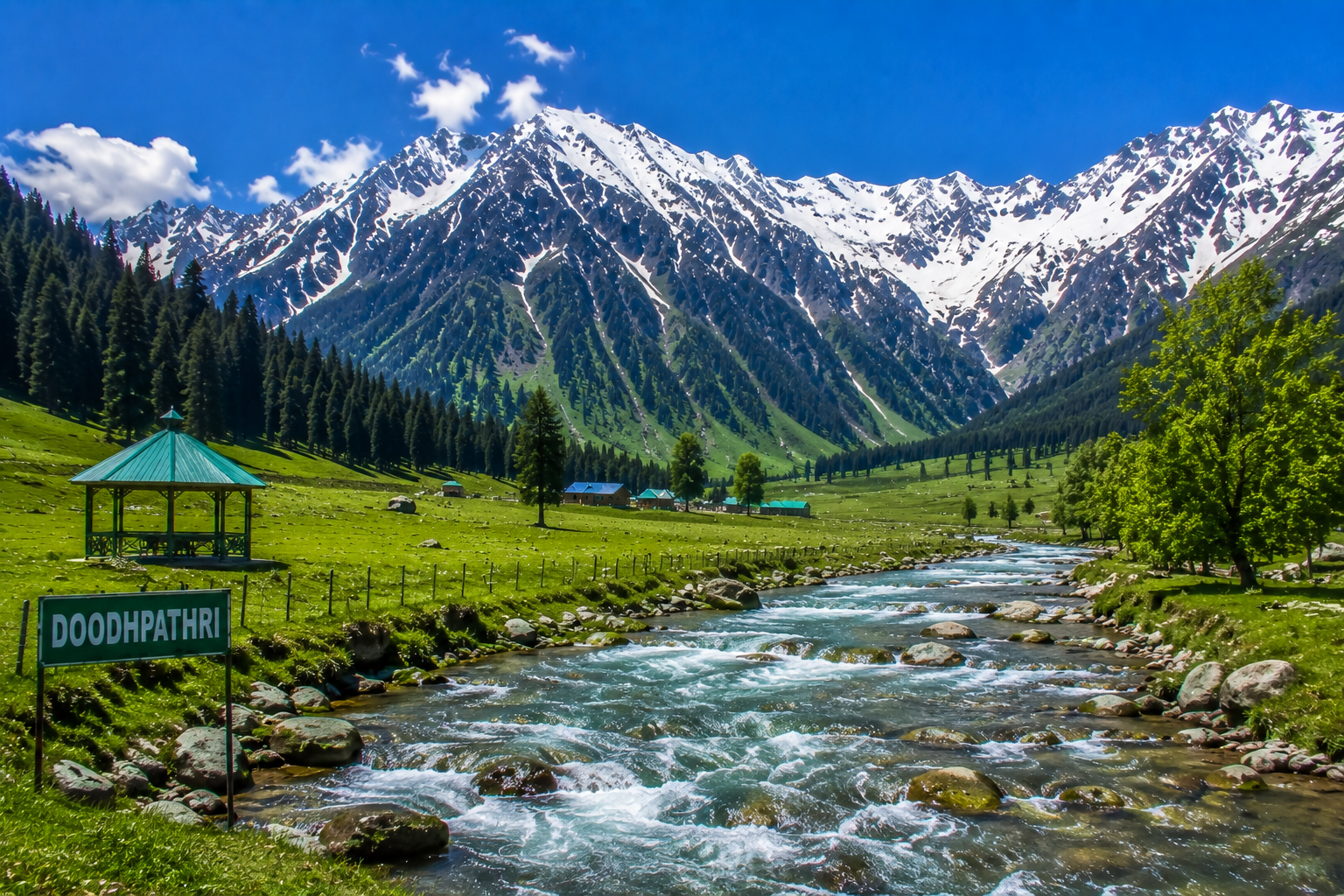
Doodhpathri, roughly two hours from Srinagar, translates to “Valley of Milk” — a reference to the mist that rolls over its meadows at dawn, not any dairy connection. It’s a wide, gentle meadow ringed by pine forest, with the Shaliganga stream running through it, and it’s popular with locals precisely because it hasn’t been built up for tourism the way Gulmarg has.
Yusmarg sits close by and offers a similar meadow-and-pine landscape, but with easy access to Nilnag Lake a short trek away — a small, still, forest-ringed lake that rarely appears on standard itineraries at all.
Gurez Valley is a different proposition altogether: a remote, high-altitude valley near the Line of Control, opened to tourism only in recent years. The Kishanganga River cuts through it, traditional wooden Dard-Shin architecture is still visible in the villages, and the drive in over Razdan Pass is itself one of the more dramatic in the region.
Bangus Valley, sometimes called the “Meadow of Meadows,” is a vast, largely untouched grassland ringed by pine-covered slopes, split into Bod Bangus and Lokut Bangus. It’s used seasonally by shepherds, and outside of that it’s often close to empty.
Tulail Valley extends beyond Gurez along the Kishanganga, and is even quieter — a good choice if Gurez itself already feels remote enough for most travellers but you want to go one step further.
A practical note: several of these areas, particularly Gurez and Tulail, are closer to the Line of Control and can require permits or have seasonal road access (heavy snow closes some routes in winter) — worth checking current requirements before you plan a trip around them rather than assuming they’re open year-round like Gulmarg or Pahalgam.